
How to Get Puppy to Stop Biting Like an Expert?
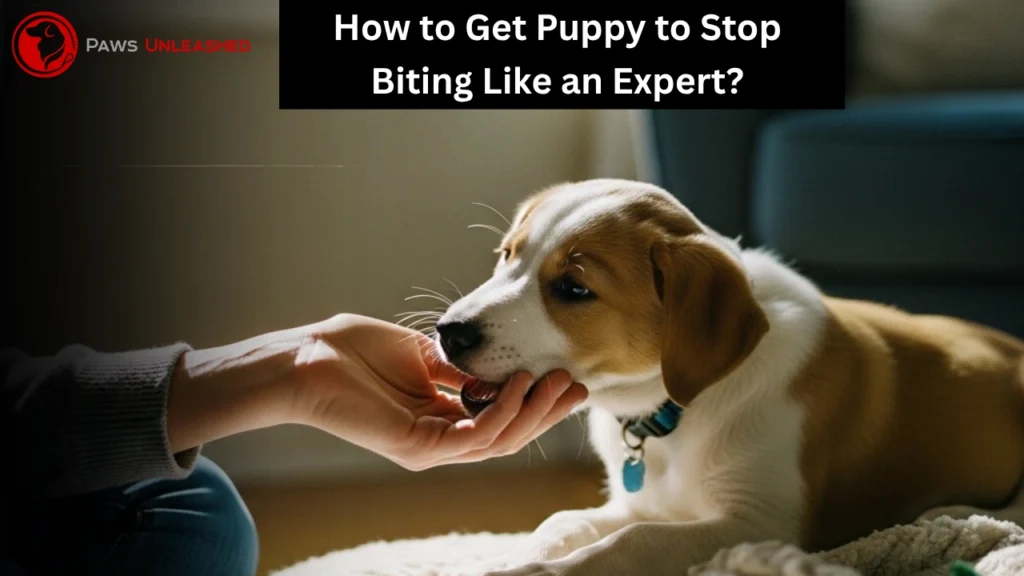
It is always so exciting when one brings a new puppy home, but there is always one annoying thing with a newly home puppy, and that is biting. Soon after acquiring a new dog, many new owners are soon wondering how to get puppy to stop biting them, particularly when the playful nips get replaced by painful bites.
The fact of the matter is that puppy biting is a normal aspect of growth. Yet, it may become a chronic behavioral issue in case it is not managed effectively. It is not only necessary to stop the biting, but to educate your puppy to act differently. You also contact PawsUnleashedUSA as they provide dog training with free evaluation.
You will also find out specifically how to get a puppy to stop biting by using some highly reviewed ideas which are accepted by the veterinary experts and take the long-run as their foundation, instead of short-term solutions.
Table of Contents
Why Puppies Bite (Understanding the Root Cause)
You must find out the reason why your puppy is acting that way before you strive to change it. The problem is that many owners fail since they consider biting to be an act of disobedience, whereas it is just a normal development stage.
The Natural Instinct Behind Puppy Biting
As humans use their hands, so do puppies use their mouths. Their early life is full of discovery as they chew and bite a lot. This is even harder during the period of the teething, their gums sore and they subconsciously seek a solution.
Moreover, biting forms one of the aspects of the way in which puppies learn social skills. When they are playing with littermates they bite each other and vice versa. Such a contact helps them know the extent of pressure that is tolerable.
Play Biting vs Aggressive Behavior
Not all biting is the same. Playing with biting is generally accompanied by a free body, a wagging tail and excitement. Conversely aggressive biting usually entails stiffness, growling, or biting in self-defense.
This difference is significant in understanding since most of the cases are merely playful and can be corrected through proper training.
When Do Puppies Stop Biting?
The second question that is asked most frequently is the duration of time spent in this phase. Whereas no definite chronology exists, the biting of a puppy usually proceeds in a more or less regular pattern.
Biting is usually at its highest in the first few months and particularly during 8-12 weeks. About 3 to 6 months, the puppy goes through the discomposure stage of teething, so again, more chewing occurs as a result of the gum irritation.
Most of the puppies with regular training would have stopped biting on a larger number by the age of six months. This habit may persist, however, without guidance and become more difficult to rectify in future.
How to Get a Puppy to Stop Biting (Step-by-Step Training Method)
A systematic process is involved in training a puppy. You should not respond arbitrarily but adhere to a rigid system that is the lesson of cause and effect.
Teaching Bite Inhibition the Right Way
The initial and the most crucial one is to teach your puppy to regulate how hard it can bite. This is what is referred to as bite inhibition. In case your puppy bites too hard, a response sound of a sharp, ouch can emulate the reaction of another puppy. This makes them realize that the bite was too tough.
After reacting, it’s important to immediately stop interacting. This will explain to your puppy that being rough will terminate fun.
Using Play Interruption as a Training Tool
Attention and play are among the most motivating things to the puppies. They will soon start to relate that behavior with negative consequences when biting brings about a playtime halt.
Rather than marking your dog, just withhold your attention. Take a step back, keep your eyes shut and wait a little before coming back to interaction. In time, you and your puppy will develop a habit of playing softly so that you can continue with the game.
Redirecting Biting to Appropriate Objects
Redirection is one of the best strategies. Puppies also require an outlet to their natural instinct to chew and not to cease the act at once, you will lead it on to acceptable objects.
Each time your puppy attempts to bite your hands or clothing, be sure to provide a chew. This enlightens them on what is permissible and avoids misunderstanding.
Reinforcing Positive Behavior Consistently
Successful training is based on positive reinforcement. Whenever your puppy selects a toy instead of your hand or plays in a toned manner, appreciate the behavior by awarding praise or gifts.
This promotes practicing and making your puppy know what you want. With time, the right behavior becomes habitual.
Managing Energy and Preventing Overstimulation
A lot of biting occurs due to the excess energy that puppies have. In the absence of appropriate physical and mental stimulation they get too excited and cause themselves to lose track.
Exercise and brief training sessions with interactive games can also help a lot to suppress biting behavior. An engaged and interested puppy would have a very lower chance of biting due to boredom.
Using Time-Outs to Set Boundaries
Last resort can be the shortening of time. It is not punitive, but a method to get your puppy to calm down.
Taking your puppy to an enclosed area with no distractions and keeping him there a few moments will help him re-steady himself. It also supports the notion that biting results in lack of interaction.
How to Get My Puppy to Stop Biting Hands and Feet
This is particularly appealing to puppies that will especially be interested in hands and feet as they move fast and get them into a chasing instinct. This renders them to be an easy target during playtime.
Rather than withdrawing your hand, which results in increased excitation to your puppy, it is best to simply sit still. This eliminates the stimulation and lessens the desire to bite.
Meanwhile, by constantly redirecting your puppy to toys, you train your puppy that hands are not chewable. It is also important to avoid rough play, which does send the wrong signals and can foster biting.
Common Mistakes That Make Puppy Biting Worse
By their well-intentioned owners, many deliberately but unwittingly ensure that the actions they are attempting to mitigate are strengthened. Inconsistency is one of the greatest errors. When biting is made permissible during play time, and when called to task at other times, the puppy is at a loss.
The other typical problem is punishment. The recovery of physical or shouting can cause fear and anxiety, which will cause rather aggressive behavior than improvement.
Rough play, e.g. wrestling with your hands, also lets your puppy know that biting is alright. Equally, snatching your hand away will make the experience worse as it evokes a chase stimulus.
These errors are generally the precipitating point of training success that is later realized and corrected.
Best Tools to Support Puppy Training
During the training methods, as much as it is important to have the right tools, it is possible to make the process easier. Teeting toys also essentially sooth agonized gums and avert the desire to chew on wrong things.
Interactive puzzles and chew toys will keep your puppy occupied and stimulated. Good behavior also can be reinforced by training treats, which make the learning process faster and more effective.
The trick is to make sure that you rotate these items on a regular basis in order to ensure that your puppy is kept interested and engaged.
How to Stop Puppy Biting Fast (What Actually Works)
When speed is what you need, consistency is the key. All communications must support this message: biting will end fun and softness will result in rewards.
Redirection can be implemented by keeping a toy within reach at any given time. Stopping the play when someone is bitten will avoid mixed messages. There is a reinforcement of behavior in calm behavior.
It cannot be fixed in a short period, however, as such strategies are pursued in a steady fashion, it is possible to make improvements visible in a couple of weeks.
When to Seek Professional Help
Puppy biting can in certain instances need expert advice. In case the behavior turns out to be intense, frequent or aggressive, it is valuable to seek help early.
Such signs as bites that break the skin, growling with biting, or nonimprovement despite repeated training are signs of the necessity to conduct professional training lke PawsUnleashedUSA in Fort Pierce, Florida. They aslo offer free evaluation for dog training or boarding.
An experienced trainer can evaluate the circumstances and offer individual approaches to your dog based on his or her behavior.
Pro Tips from Dog Training Experts
According to the experienced trainers one of the key points is the emphasis of structure and routine. Puppies need a consistent environment with which they are able to learn.
Another important criterion is socialization. Exposing your puppy to other people, settings and other dogs allows them to grow up with the right behavior and lowers fear related responses.
Basic commands like to leave it, or to be gentle may also be taught offering further control in the matter of when biting may take place.
Final Thoughts
Knowledge on how to get puppy to stop biting is not concerned with ceasing bad habit and that is, it is concerning teaching your puppy how to be with people and learn to handle them and others safely and appropriately.
Your puppy will learn within no time, with patience, consistency and use of the appropriate techniques. The biting stage is not permanent however habits that you are teaching your dog now will have an effect throughout the life of your dog.
FAQs About How To Get Puppy To Stop Biting?
How do I get my puppy to stop biting me?
Stopping play and refocusing on a toy, and praising mild behavior is the best way to do it.
How can I get my puppy to stop biting fast?
We get faster results through consistency, proper redirection and by making sure that your puppy receives adequate physical and mental activity.
Why does my puppy bite me aggressively?
This can be as a result of being overstimulated, having fears or being untrained. Body language can be used to determine the cause.
Do puppies grow out of biting?
They naturally improve to some extent, and not trained up until adulthood, the behavior may go on.
What is the fastest way to stop puppy biting?
The fastest method is combining redirection, stopping play, and rewarding calm behavior every single time.